Non-smooth Systems

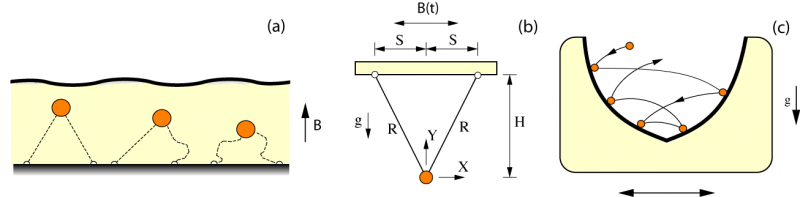
Many dynamical systems (especially mechanical) have discrete non-smooth characteristics. A good number of such systems have been studied in the nonlinear dynamics group here at Duke. One of the motivations for this work is that impacting systems often exhibit limited fatigue life. Non-smooth systems are capable of exhibiting behavior not found in smooth systems, e.g., grazing bifurcations. The systems below have a non-smooth stiffness characteristic:

Image
ns-cartoons+ copy

Some other examples are show here:

Image
ns
Image
ns3
Image
ns4

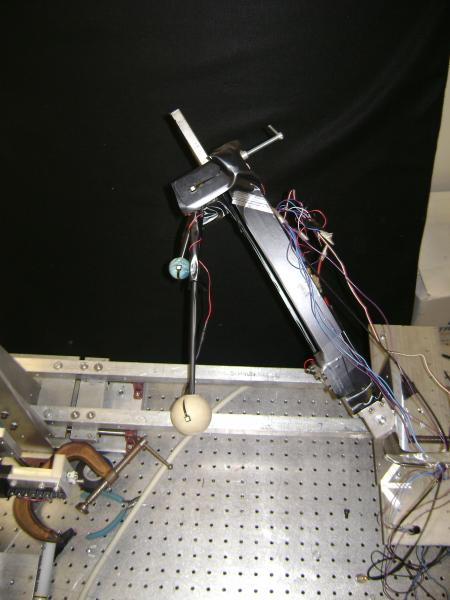
Another example is a double-pendulum impacting system:
Image
2pendulumPic

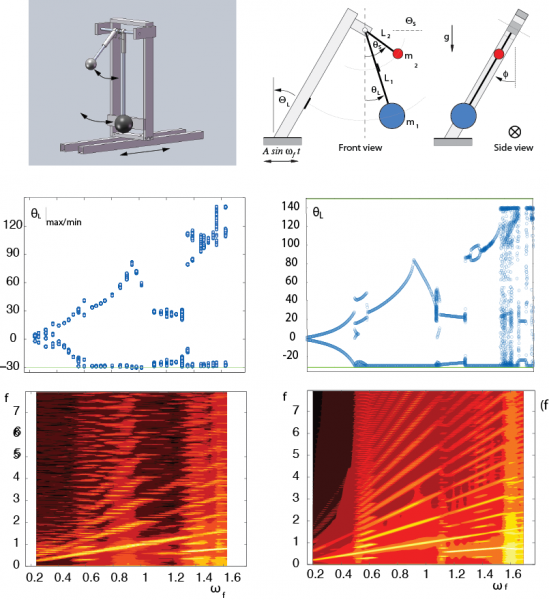
Simulations and experimental data compare very favorably, not just for specific parameter values, but across a broad range (bifurcation diagram and spectragrams). Experimental data on the left, numerical simulation on the right:
Image
spectro

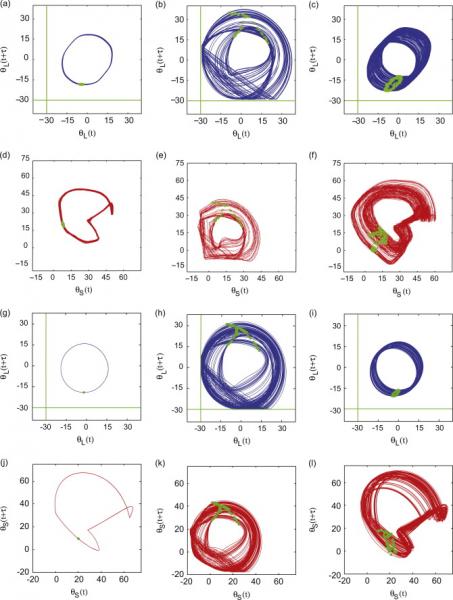
The response at given frequencies can be quite different. For example, below is shown both numerical and experimental data in terms of pseudo-phase projections and Poincaré points (in green) superimposed. (a) - (f) Experimental, (a) and (d) ωf = 1.43, (b) and (e) ωf = 0.58, (c) and (d) ωf=1.51. (g)–(l) Numerical, (g) and (j) ωf=1.415, (h) and (k) ωf=0.5719, (i) and (l) ωf = 1.43.
Image
double_phase

Ball rolling on a surface

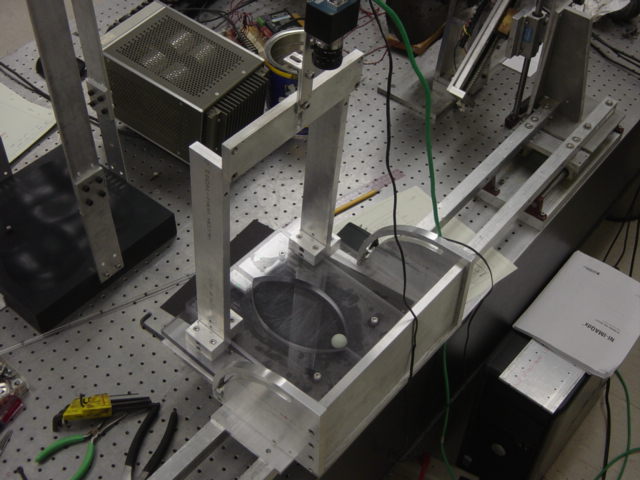
A Rolling Ball System. A conventional paradigm of linear oscillations is the motion of a small ball as it rolls on a parabolic curve with minimal energy dissipation. The unique minimum provides a compelling demonstration of stable equilibrium. If the curve is then shaken at close to the natural frequency of the ball then a large amplitude response occurs due to resonance may occur.

Image
surface

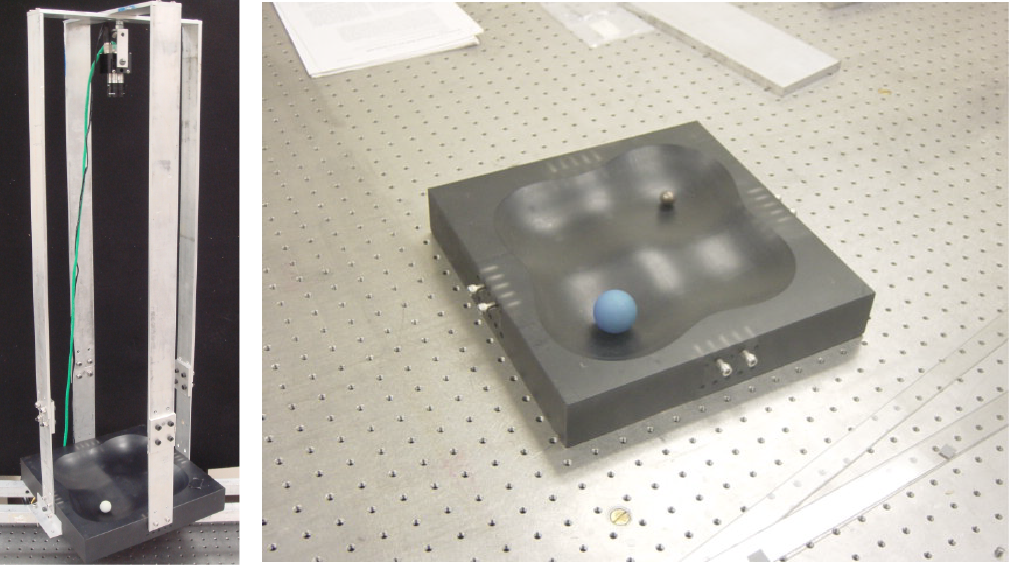
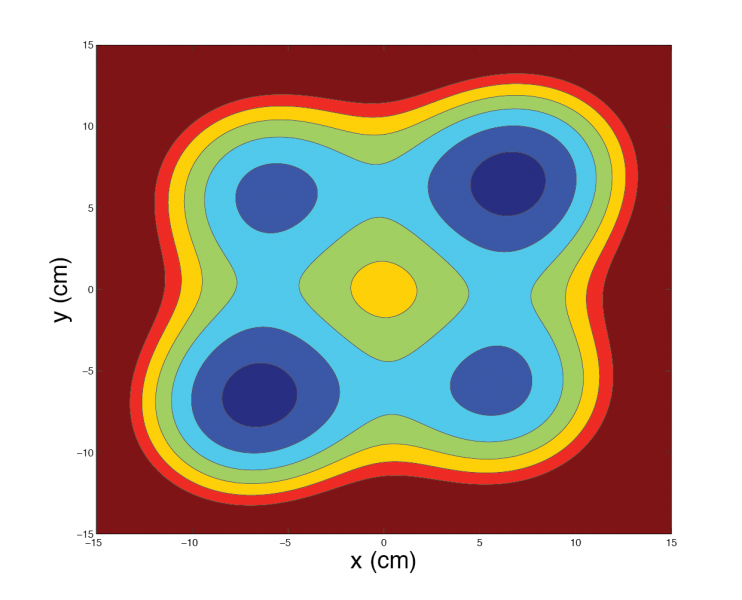
If we take this concept a couple of steps further we can envsion a small ball rolling along a two-dimensional surface, and furthermore, we can design the surface to exhibit various maxima and minima. Now, given some uncertainty in the initial conditions it can be very difficult to predict which long-term behavior (in this case a surface minimum) the ball will eventually end up in (given a little energy dissipation). And if we shake the surface harmonically (say) then chaos is a typical response.

Here is a contour plot of the surface:

Image
surfacecontour copy

and the plots below show initial conditions for the unforced case in which the ball ends up in one of the four minima due to energy dissipation. In these cases the ball is started from rest, i.e., the initial velocity components are zero.

Image
ic

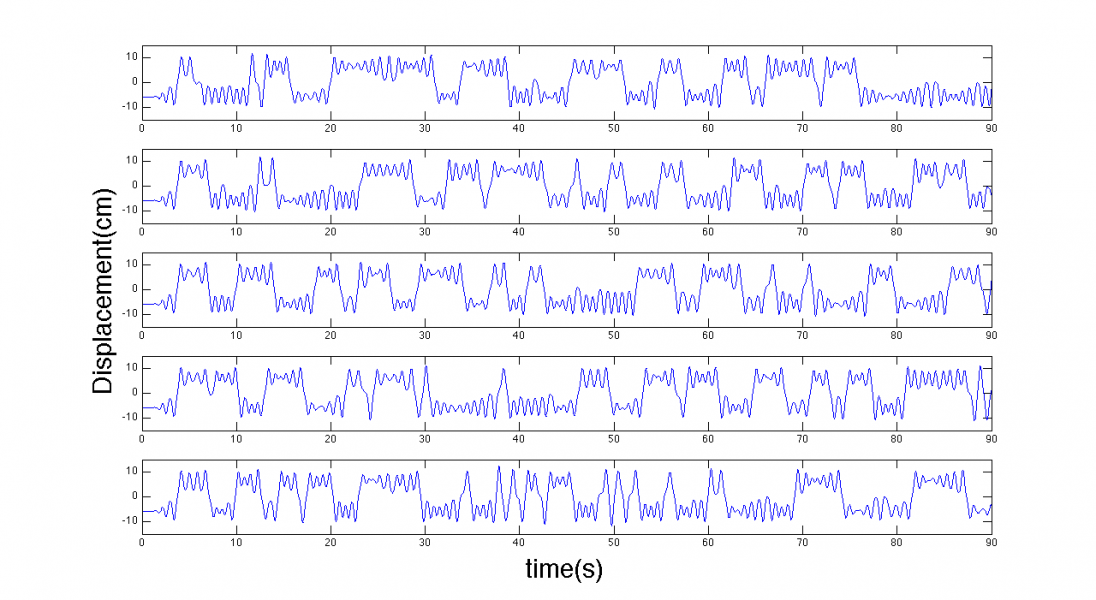
The forced case can produce chaos, first shown as time series and then as phase trajectories:

Image
sharp2

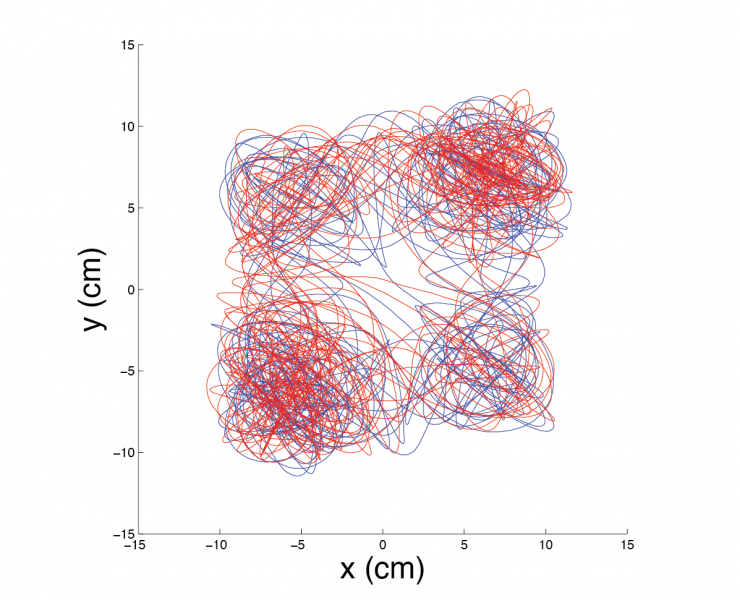
In the phase projection trajectories overlap (the phase space is 5-dimensional). In both cases (red and blue) the ball is at rest when the forcing is switched on (at the same forcing phase). The inevitable (tiny) difference leads to exponentially diverging behavior - a hallmark of chaos.

Image
newmultiwellxy

Nonlinear Aeroelasticity

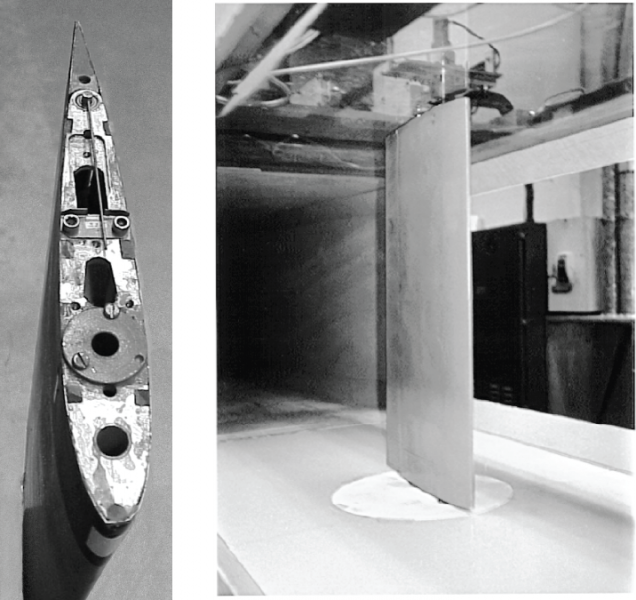
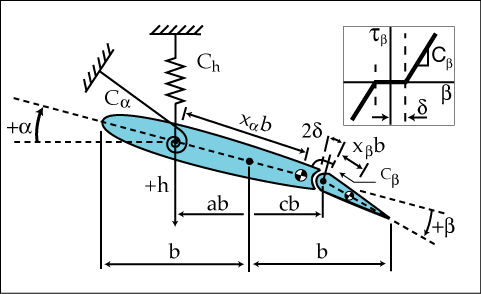
The nonlinear behavior and flutter characteristics of an aeroelastic system with control surface freeplay provides a platform for studying some interesting behavior. A low-order, state-space numerical model of the aeroelastic typical section was created which allows for the inclusion of structural freeplay and preload in the control surface degree of freedom. A physical model of the system was also constructed for use in the Duke University low-speed wind tunnel.

Image
airfoil
Image
section

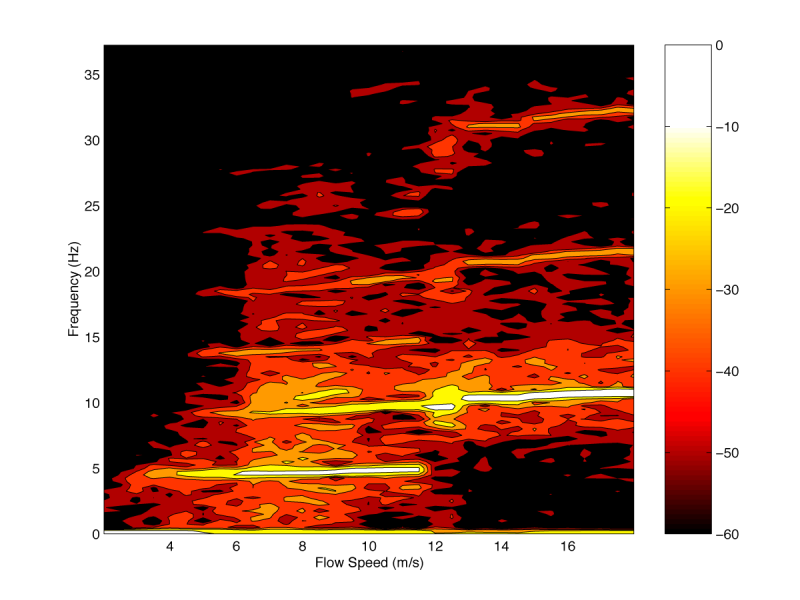
One of the most interesting aspects of the behavior of the airfoil is that hysteresis (between types of limit cycle behavior) is present. That is, the type of (flutter) response and the flow speeds at which they occur depends on whether the flow rate is increasing or decreasing. This is nicely captured by the spectrograms shown below.

Image
spec1
Image
water1

More details of this research can be found in the paper published in the Royal Society in 2002.

Basins of Attraction

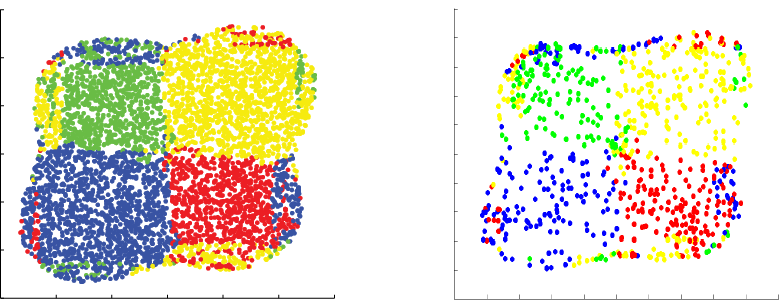
This research considers a global behavior aspect of nonlinear systems - basins of attraction in systems exhibiting bi-stability. Mapping out the final destination of a grid of initial conditions in numerical simulation is quite straightforward. Experimentally, it is much more challenging. However, a system can be subject to a random sequence of disturbances, and making use of a few techniques from nonlinear dyanmics allows a systems dependence on initial conditions to be examined. The following are simply colorful examples, but they can be cross-referenced back to the appropriate publications, listed to the right.

The important point of this research is that (in contrast to linear systems) nonlinear systems are capable of exhibiting long-term recurrent behavior that depends on where the system was started from, and in some cases this dependence on initial conditions is extremely sensitive.

One of the key engineering contexts for basins of attraction is found in the buckling behavior of slender axially-compressed structures:

Image
snap1

Here is an example of a repeatedly and randomly perturbed system with three co-existing attractors:

Image
si

Here are basins of attraction from various mechanical experiments:

Duffing cart/track:

Image
Slide32
Image
Slide33
Image
Slide34
Image
Slide35


 Morphing basins in a link model:

Image
Slide29
Image
Slide30


And some basins for an impact-friction oscillator:

Image
Slide41
Image
Slide42


Image
Slide43